Galilee Baptist Church
Galilee Baptist Church has long served as one of the Westside community’s most important institutions. Galilee was first formed in 1918 on Brothers Street at a location first known as Myrtlewood Homes and now Gateway Village under the leadership of Reverend Yank Townsend. Reverend Yank Townsend served as the first pastor in a small storefront church.
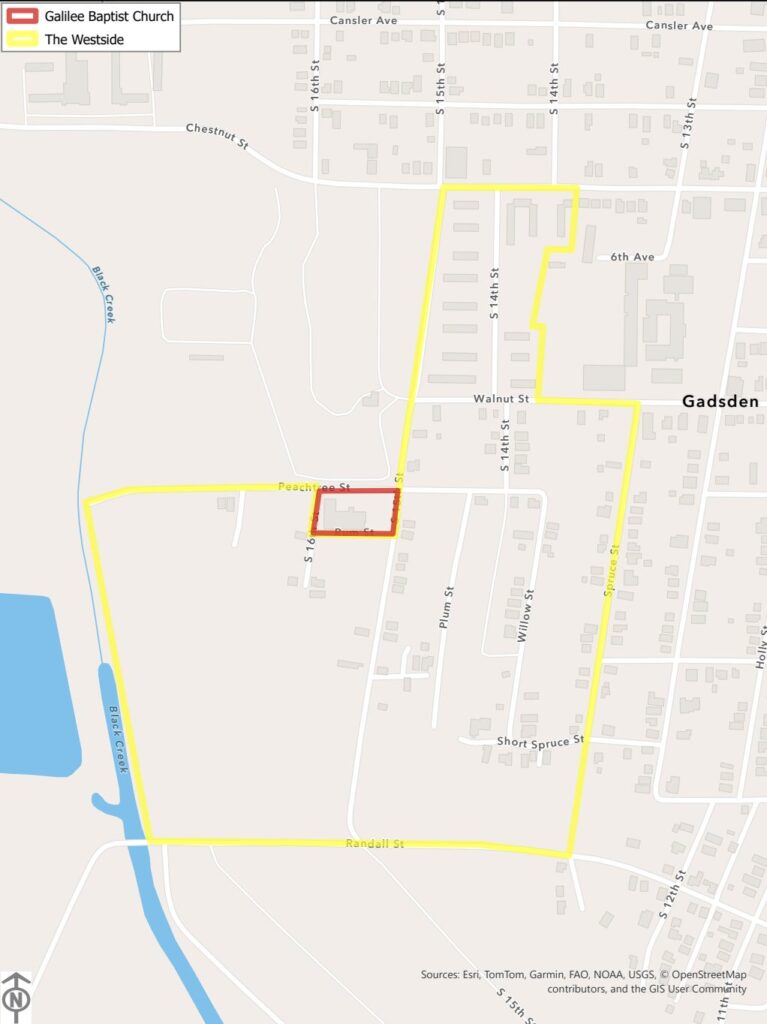
The church later moved to its location on 16th Street under a brush harbor. Reverend Townsend served for one year. Under the leadership of Reverend Ed Gates, the church was given the name Galilee Baptist Church. A few years later, a 28-by-14-foot plank building was erected. The church grew under the ministries of Reverends C. J. Mallory and C. Harris. The membership continued to grow, and the small plank building became too small. In 1924, Reverend Harris saw the need for a larger building, and the Old Galilee Baptist Church was started. The building sat on a knoll at the corner of Peachtree Street and South 16th Street. It was “tucked between two other hills” and sat diagonally across from what is now the historic Forrest Hill Cemetery. The church membership continued to grow under Reverends W. C. Crosby, C. C. Welch, and O. P. Wollen. Each served for several years, but the church building was not completed. Progress was slow due to the Great Depression.
Reverend Ed Gates, along with Reverends C. J. Mallory, C. Harris, W. C. Crosby, C. C. Welch, and O. P. Wollen, shared leadership over the next fourteen years until Reverend E. L. Gary was called in 1934. Reverend Gary served for thirteen years until 1947. Under his administration, the church building was completed, and a note-burning ceremony was held. Afterwards, Reverend B. L. Walker pastored for one year until the selection of Reverend E. W. Jarrett in 1948.
Reverend Jarrett served Galilee and the community for twenty-five years, from 1948 to 1972. At the time of his call to Galilee, the church was holding services only twice per month, the streets were unpaved, and there was no sewage system. The first thing Reverend Jarrett did was establish full-time church services and set up a church office. This young, energetic leader organized the community, established committees, drafted petitions, and within nine months, sewage service was installed and the streets were paved. Under Jarrett’s supervision between 1955 and 1960, an educational wing with fifteen classrooms was added to the church.
Because Reverend Jarrett was a natural leader with exceptional God-given talents, he did not hesitate to bring politics and business into religion. He was instrumental in organizing portions of the Gadsden community during the Civil Rights Movement of the 1950s and 1960s. As part of his civil rights efforts, he helped arrange mass meetings that occurred on average twice a month during the 1960s, established related committees, and organized freedom marches while using Galilee Baptist Church as his headquarters. These mass meetings were particularly impactful because Dr. Martin Luther King Jr. and members of his leadership team, including Reverends Ralph Abernathy and Jesse Jackson, frequently spoke from Galilee’s pulpit, offering encouragement and guidance to those involved in the movement.
Reverend Jarrett’s talents were respected throughout the South. He was frequently recruited by churches across Alabama and beyond because of his oratorical and organizational abilities. In 1972, he accepted a call to Trinity Baptist Church in Birmingham, Alabama.
Galilee was without a pastor for one year, from 1972 to 1973. In March 1973, Reverend G. E. Robinson was unanimously chosen and would serve for fifty-one years, from April 1973 until April 2024. Reverend Robinson’s service brought many changes and improvements to Galilee. During his first year, major renovations included a large entryway and foyer with stairs leading into the main sanctuary, a prayer room, and much-needed replacement of windows and lighting. The former Robert Colley School building was purchased, renovated, and transformed into the Educational Annex Building.
In 1992, Galilee remodeled the old Robert Colley School building, adding a sanctuary and relocating worship services to the 901 South 15th Street location. The original church structure on 16th Street was left standing. Due to its historical significance, the Old Galilee Baptist Church building on 16th Street was officially registered as a historic site by the Alabama Historical Commission on October 12, 2016. This designation was a significant achievement; however, the original church building was imploded in July 2017. The property now serves as parking space for the main church campus on 15th Street.
On December 27, 2024, Reverend G. E. Robinson passed away. On January 26, 2025, his son, Reverend Grover Robinson, was installed as the new pastor of Galilee Baptist Church. Under his leadership, the church experienced renewed growth in membership and continued its tradition of faith and service. Sadly, Reverend Grover Robinson passed away on November 8, 2025. The church remained without a pastor until March 2026, when Reverend DeWayne Keith was called to serve. Reverend Keith was officially installed as pastor on April 26, 2026.
Over the decades, Galilee Baptist became far more than a church. It functioned as a spiritual center, community gathering place, leadership institution, and source of support for neighborhood families. The church’s membership reflected the working-class character of the Westside, and many members were employed in local industries and public institutions.
One of the church’s oldest documented families was that of Tommie “Tom” and Lucille Scott. According to local records, Tommie Scott helped construct the church’s first building, and the Scott family became among the congregation’s earliest members. Lucille Scott later worked at Robert Colley School for more than thirty years, illustrating the close relationship between the church and the neighborhood school.
Today, Galilee Baptist Church remains one of the most recognizable landmarks in the Westside community and continues to serve as a center of faith, leadership, and community service.