Norfolk Southern Railway

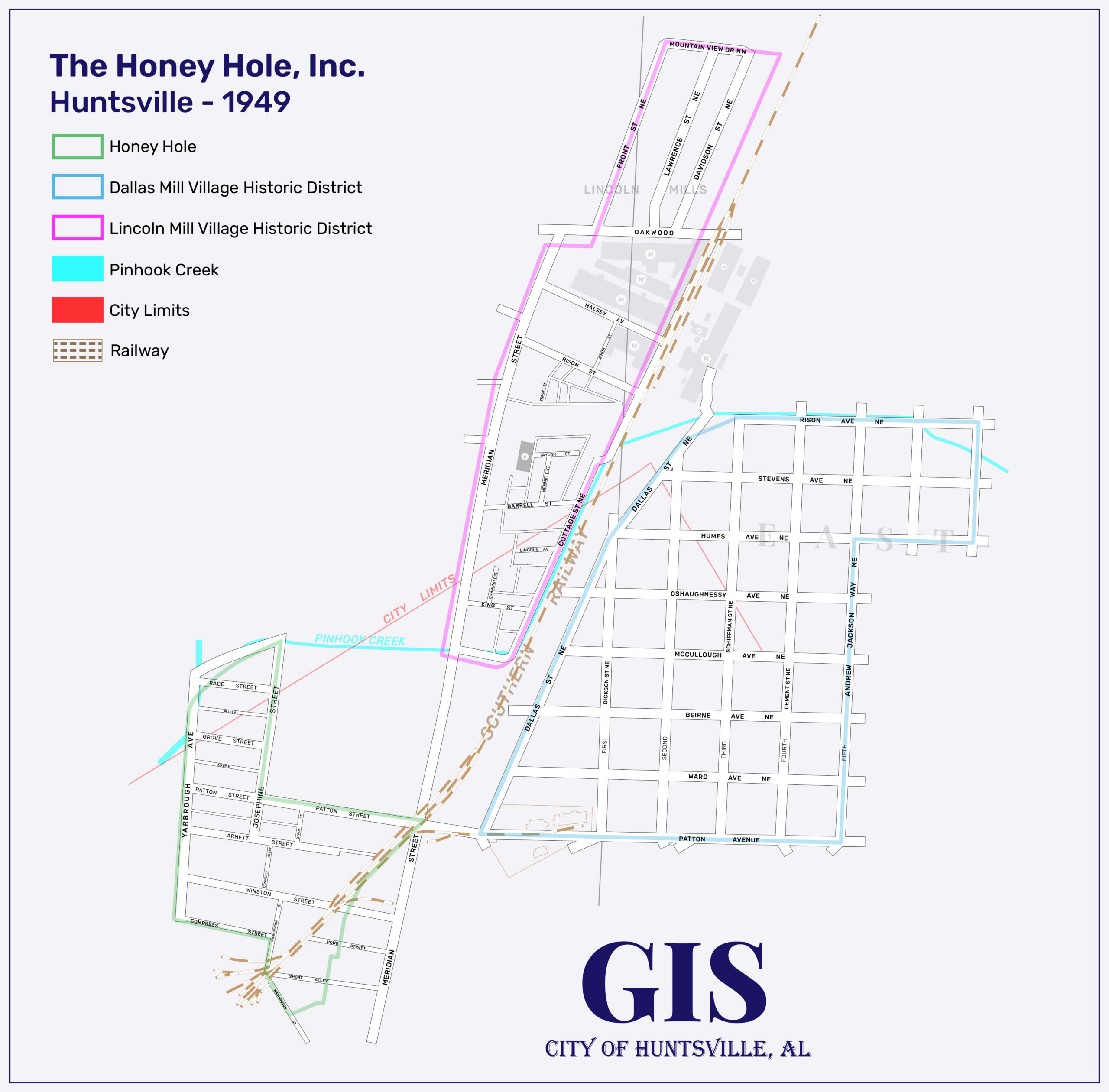
The Southern Railway (now Norfolk Southern Railway) ran directly through and alongside the Honey Hole community, cutting diagonally across the area

Streets like Patton, Winston, and Howe were positioned relative to this rail corridor

The neighborhood sat near:

    • Creek systems (Pinhook Creek)
    • City limits
    • Industrial zones

This layout tells an important story:

The Honey Hole was not incidental—it was shaped by the railroad.

Southern Railway (Now Norfolk Southern) and the Honey Hole Community

Based on the map and historical patterns, the railroad likely influenced the Honey Hole in several key ways:

  1. Employment and Economic Role

Residents of the Honey Hole likely worked in:

  • Rail-related labor
  • Nearby industrial facilities
  • Support services tied to freight movement

Railroads provided:

  • Stable, though often physically demanding, jobs
  • Opportunities for Black workers in an otherwise limited economy
  1. Spatial and Social Boundaries

Rail lines often acted as dividing lines:

  • Separating neighborhoods by:
    • Race
    • income
    • land use

In the South, this frequently meant:

  • Black communities located near industrial zones and rail corridors
  • White residential areas located farther away

The Honey Hole’s proximity to:

  • Rail lines
  • Creeks
  • Industrial space

suggests it was part of this broader pattern.

  1. Environmental and Living Conditions

Rail-adjacent communities often faced:

  • Noise and vibration
  • Air pollution from locomotives
  • Limited infrastructure investment

Yet despite these challenges, these communities developed:

  • Strong social networks
  • Cultural identity
  • Deep ties to place

Southern Railway (Now Norfolk Southern) and Nearby Mill Villages: Lincoln Mills & Dallas Mills

The Honey Hole did not exist in isolation—it was part of a broader industrial ecosystem that included:

Lincoln Mills

  • A major textile mill in Huntsville
  • Dependent on rail for:
    • Raw materials (cotton)
    • Shipping finished goods

Dallas Mills

  • Another large textile operation
  • Similarly reliant on rail connections

The Role of Southern Railway (Now Norfolk Southern)

The railway system was part of the Southern Railway network, which later became part of Norfolk Southern.

Southern Railway:

  • Was a dominant force in the Southeast
  • Connected mills, farms, and cities
  • Enabled Huntsville’s growth as an industrial hub

Influence on Local Communities

In areas like the Honey Hole:

  • The railroad enabled:
    • Industrial employment
    • Movement of goods and labor
  • It also reinforced:
    • Segregation patterns
    • Economic stratification

For mill communities like Lincoln and Dallas Mills:

  • Railroads were essential to their operation